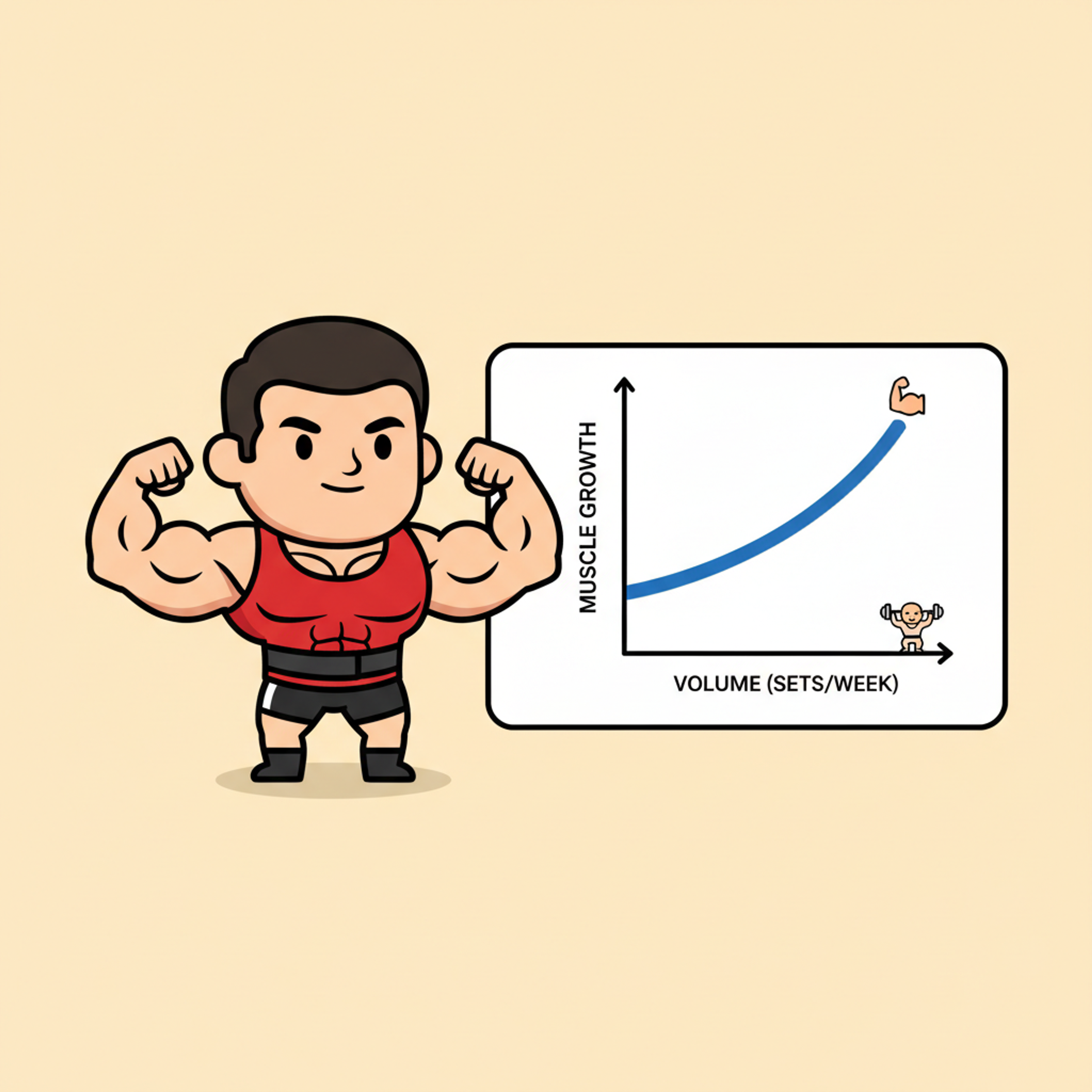
Muscle growth follows a diminishing returns curve. There is a physiological limit to how much anabolic signaling a muscle can receive in a single session. Once you cross that threshold, you are doing "junk volume"—work that generates fatigue without stimulating further adaptation.
The Dose-Response Curve
The relationship between volume (hard sets) and hypertrophy is not linear; it is curvilinear.
- The trigger: Mechanical tension initiates the signaling cascade.
- The saturation point: After a certain number of effective sets, the mTOR pathways become saturated. More tension does not turn the dial up further.
- The cost: Every set—effective or not—generates metabolic waste, muscle damage, and central fatigue.
- Effective volume: Stimulus > fatigue cost.
- Junk volume: Fatigue cost > stimulus.
The Volume-Efficiency Spectrum
"Sets" here means hard sets—RPE 7 to 10.
Weekly sets per muscle | Classification | Efficiency | Who it suits
1–4 | Maintenance dose | Very high | Injured athletes, busy professionals, in-season
5–9 | Low volume / high intensity | High | Novices, strength-focused powerlifters
10–20 | Optimal hypertrophy | Moderate | Intermediates, bodybuilders
20–30 | Maximal overload | Low | Advanced / elite
30+ | Junk volume zone | Negative | Nobody
A few things worth noting:
- The first four sets for a muscle provide roughly 60–70% of the total possible growth stimulus from a session. This is why minimalist training works surprisingly well.
- Moving from 5 to 10 sets adds meaningful growth.
- Moving from 10 to 20 sets adds some more, but the cost per unit of muscle grows significantly. You work twice as hard for roughly 10% more result.
Practical Application
The "more is better" problem:
Chest day looks like this: Flat bench (5×10), incline dumbbell (5×10), decline machine (4×12), cable flies (4×15), pec deck (4×15), push-ups to failure. Roughly 25 sets.
By set 12, the chest is fully pumped, glycogen is depleted, and motor unit recruitment is dropping due to peripheral fatigue. Sets 13–25 increase cortisol and muscle damage markers without increasing protein synthesis. Recovery takes 5–7 days, which means the next chest session is limited before it even starts.
The high-quality alternative:
Flat dumbbell press (3 sets, RPE 9), incline barbell (3 sets, RPE 8), weighted dip (3 sets, RPE 9). Nine sets total.
Every set is performed with freshness and mechanical tension. Because you only did 9 sets, you recover in 48 hours. You can hit chest again later in the week for another 6–8 quality sets.
Result: 15–18 high-quality sets spread across the week, each with a strong stimulus—versus 25 low-quality sets crammed into one session where half of them were junk.
Volume is a tool. Distribute it intelligently.
About Rasmus
Powerlifter and coach with more than 7 years in the game.