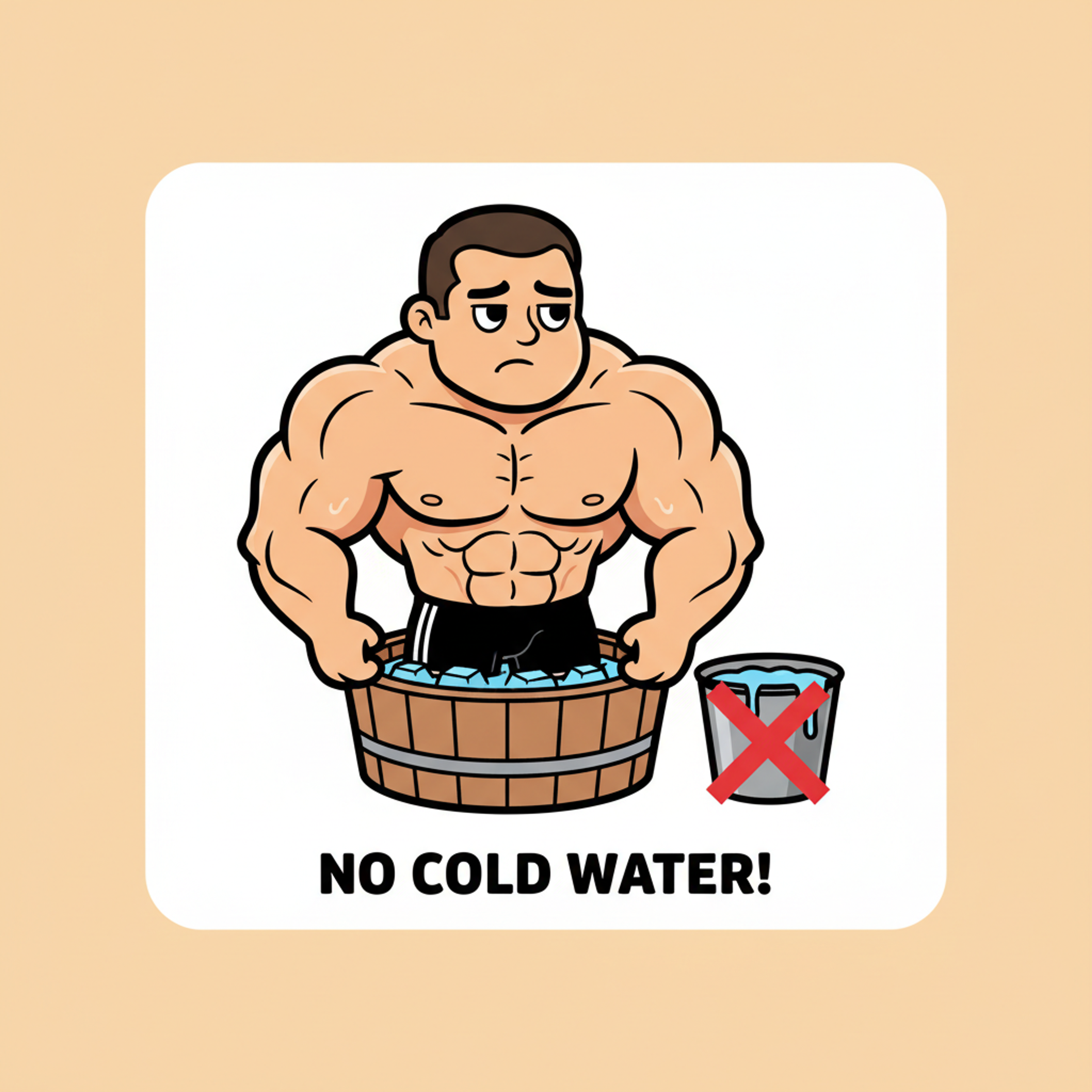
Watch the NFL or NBA and you'll see athletes sitting in tubs of ice. It looks hardcore. The logic follows the "no pain, no gain" fallacy: if it hurts, it must be working.
Context is everything. What works for an athlete trying to play two games in 48 hours might be actively sabotaging your gains in an off-season building block.
Cold Water Immersion (CWI) is a tool, not a vitamin. It is excellent at one specific thing: acute performance restoration. It is terrible at another: long-term physiological adaptation.
The Mechanism: Inflammation as a Signal
To understand why CWI is controversial, you need to understand how growth works.
- The stimulus: Heavy training causes mechanical stress and micro-trauma to muscle fibers.
- The signal: This trauma triggers an acute inflammatory response. Macrophages flood the site. Cytokines are released.
- The response: This "bad" inflammation is actually the chemical signal that calls in satellite cells—stem cells that proliferate, fuse to the muscle fiber, and donate nuclei to support new protein synthesis.
What cold water does:
CWI causes vasoconstriction. Blood flow and tissue temperature drop sharply. This suppresses the inflammatory cascade.
By "putting out the fire" of inflammation, you also silence the signal for the fire department (satellite cells) to come and rebuild. You feel less sore, but you have chemically blunted the adaptation process.
When to Use It and When to Avoid It
Research clearly shows that regular post-exercise cooling attenuates hypertrophy and strength gains.
| Hypertrophy block | Peaking / competition | Injury management
Primary goal | Maximize structural change | Maximize acute output | Reduce excessive swelling
CWI verdict | Avoid | Use | Context dependent
Off-season (building):
You want the inflammation. You want the metabolic byproducts to hang around long enough to trigger the stress response. Avoid CWI for at least 6–8 hours post-training. Ideally, skip it entirely. Active recovery (walking) and good nutrition are sufficient.
Competition / high-frequency block (surviving):
A CrossFit athlete at a three-day event or a soccer player with back-to-back matches has a different problem. They do not care about building muscle right now—they need to perform tomorrow. CWI flushes waste products and numbs pain receptors. Use it.
- Protocol: 10–15 minutes at 10–15°C, immediately post-competition.
- The trade: long-term adaptation for short-term availability. Conscious and sometimes correct.
Practical Application
Scenario: The overzealous recoverer.
Finishes a heavy squat session, then immediately jumps into a cold plunge because a podcast said it boosts dopamine.
Mentally, they feel great. Physically, they have blunted the anabolic signal of the workout they just suffered through. They did the work and declined the paycheck.
Scenario: The calculated athlete.
A competitive lifter 3 weeks out from nationals. Training frequency is high, joints are inflamed, sleep is suffering.
They use CWI only on rest days or after the final session of the week—far removed from any primary training session. The analgesic effect manages joint inflammation without directly interfering with the post-workout adaptation window.
Inflammation is not the enemy. Chronic, systemic inflammation is. Acute, localized inflammation after training is the mechanism of growth.
About Rasmus
Powerlifter and coach with more than 7 years in the game.