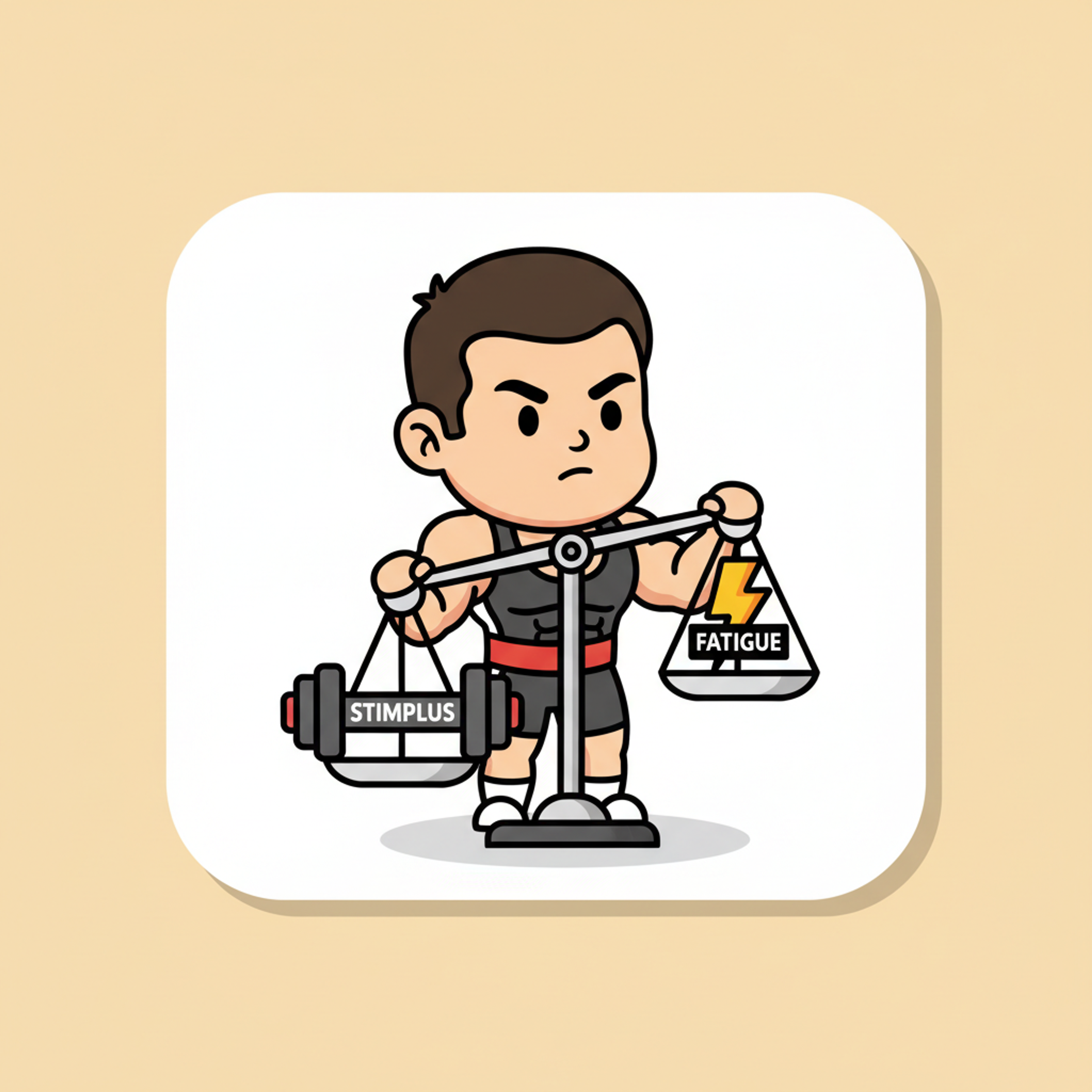
Training is a transaction. You pay with fatigue, and you buy adaptation.
The Stimulus-to-Fatigue Ratio (SFR) is your ROI calculator. How much growth are you getting for every unit of fatigue this exercise generates?
If you are "hardcore" but small, you probably have a portfolio full of bad investments.
High SFR vs. Low SFR
Low SFR (Bad Investment)
High systemic fatigue, high joint stress, low local muscle stimulation.
- Example: Conventional deadlift for hypertrophy.
Cost:* Crushes the central nervous system, compresses the spine, takes 4–5 days to recover from.
Benefit:* Hits hamstrings and glutes, but the lower back often gives out before the legs do.
Verdict:* Terrible for pure hypertrophy. Essential for strength sport if it's your sport.
High SFR (Good Investment)
Low systemic fatigue, high local muscle stimulation, safe failure point.
- Example: Hack squat or leg press.
Cost:* Zero axial (spinal) load. The machine handles stability.
Benefit:* You can take your quads to absolute mechanical failure, do drop sets, do partials.
Verdict:* Excellent for hypertrophy. You recover faster and can train again sooner.
The Powerlifter's Dilemma
A powerlifter must do the low SFR movements—squat, bench, deadlift—because they are the sport. You cannot win a meet on the leg press.
But they should not use the big three exclusively for hypertrophy work.
- The mistake: 5×10 squats followed by 5×10 deadlifts.
- The result: Lower back is fried. Knees hurt. Sleep 10 hours and wake up tired. No energy left for isolation work.
The big lifts earn their place in the program. They shouldn't double as your hypertrophy tools.
The Bodybuilder's Advantage
Bodybuilders have no mandatory lifts. They can cut low SFR exercises without consequence.
- Why barbell row (high lower back fatigue) when you can chest-supported row (zero lower back fatigue)?
- Why barbell squat when you can pendulum squat?
Auditing Your Program
Look at your accessory work. Are you doing exercises that exhaust you systemically but fail to isolate the target muscle?
The weak link test: When you fail a set, what gave out first?
- The target muscle (e.g., quads in a leg extension) → High SFR. Keep it.
- The stabilizers (e.g., lower back in a bent-over row) → Low SFR. Replace it with a chest-supported row.
- The lungs (e.g., running out of breath in a high-rep squat) → Low SFR. Replace it with the leg press.
Recommended swaps for accessory work:
- Quads: Barbell squat → hack squat / leg press.
- Hamstrings: Stiff-leg deadlift → seated leg curl.
- Back: Barbell row → chest-supported T-bar row.
- Triceps: Close-grip bench → cable pressdown / skullcrusher.
About Rasmus
Powerlifter and coach with more than 7 years in the game.