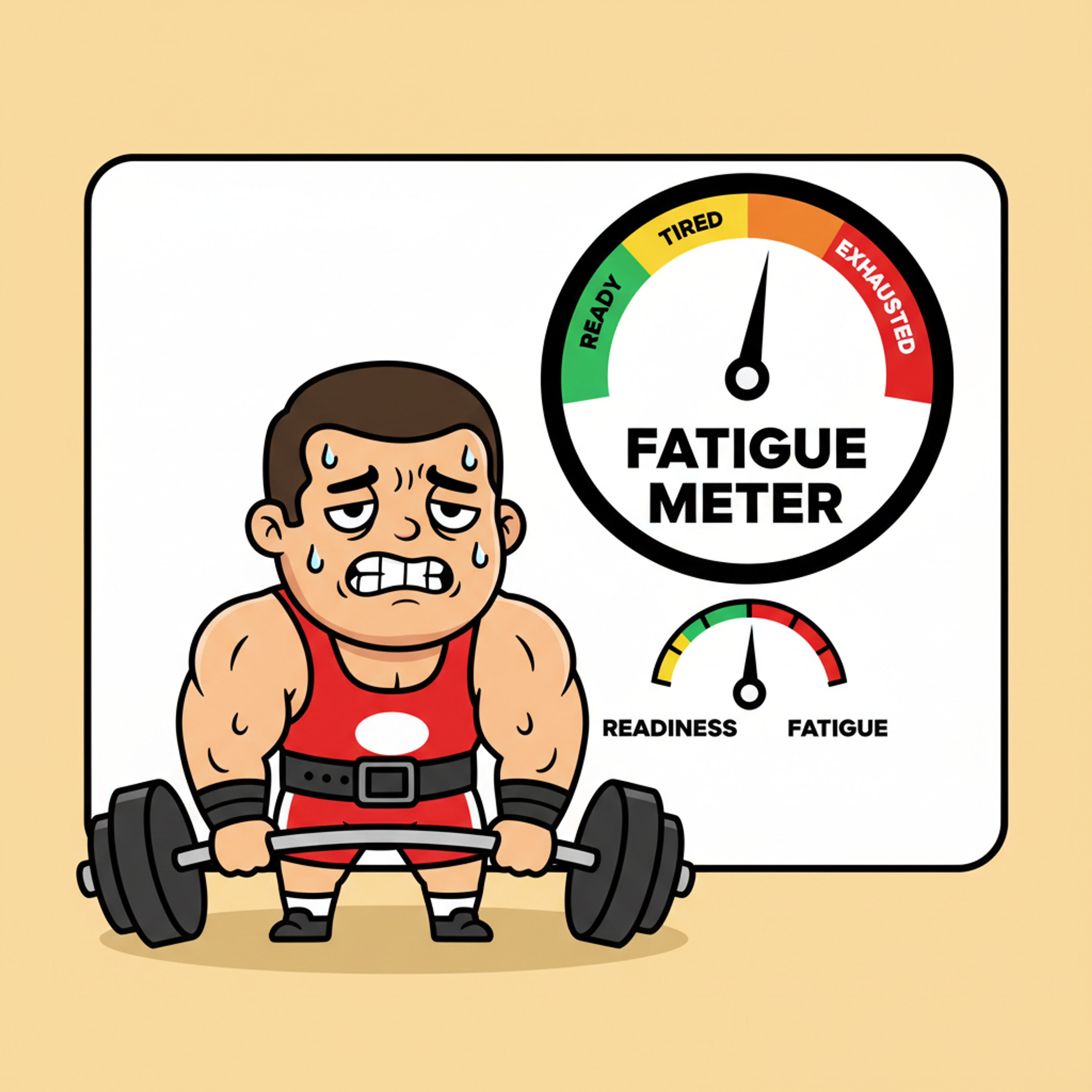
Most programs assume you are a robot. They prescribe "5 sets of 5 at 80%" on Tuesday regardless of whether you slept 8 hours or 3, or whether work stress is through the roof.
The body does not care about your spreadsheet.
Autoregulation is adjusting your training load in real time based on your actual capacity. This is not "listening to your body" as an excuse to go easy. It is a practical system for matching what you ask of yourself to what you are currently capable of giving.
(Note: The mechanics of RPE and VBT as tools are covered in the Cybernetic Periodization article. This article focuses on the fatigue side—why you need to manage it, and how to apply autoregulation when things go wrong.)
The Mechanism: General Adaptation Syndrome
Training is a stressor. Your body responds through three phases:
- Alarm phase: The workout causes damage. Performance drops.
- Resistance phase: Recovery kicks in. Protein synthesis rises.
- Supercompensation: Performance rebounds above the previous baseline.
The failure mode is simple: if you train again before the resistance phase is complete, you do not supercompensate. You dig a deeper hole. Do this often enough and you slide into overreaching—or worse, overtraining.
Autoregulation ensures you are training within your current adaptive capacity, not exceeding it.
RPE and RIR: Proximity to Failure
The two metrics that make autoregulation practical are RPE (Rate of Perceived Exertion) and RIR (Reps In Reserve). They are two ways of expressing the same thing.
RPE / RIR | Perceived effort | Hypertrophy stimulus | Recovery cost
10 / 0 RIR | Maximal. Nothing left. | Maximal (diminishing returns) | Very high (48–72h)
9 / 1 RIR | Hard grind. One rep left. | High | High (24–48h)
8 / 2 RIR | Hard but controlled. | Moderate-high (sweet spot) | Moderate (repeatable daily)
7 / 3 RIR | Fast bar speed. | Moderate | Low
6 / 4 RIR | Technical focus. | Low | Very low
Why RPE 8 beats RPE 10: Motor unit recruitment is nearly maximal at RPE 8. Going to RPE 10 recruits the last few high-threshold fibers, but at disproportionate metabolic and neural cost. Three sets at RPE 8 produces a greater total growth signal than one set at RPE 10 followed by a performance collapse.
When It Matters Most
Scenario: The high-readiness day.
4 weeks from a meet. Sleep is perfect, nutrition is on point.
- Program: Squat 3×3 at RPE 8.
- You warm up. 200kg moves like air.
- You load 220kg for 3 reps. It feels fast. You had 6 in the tank. That is RPE 7.
- Adjustment: Increase to 230kg for the next set.
- Outcome: You capitalized on high readiness and pushed the baseline higher instead of leaving gains on the floor.
Scenario: The trash day.
Newborn baby. Three hours of broken sleep. Hydration is coffee.
- Program: Squat 3×3 at RPE 8.
- 200kg (your usual working weight) feels like a house. Three reps, real grind, knees slightly caving. That is RPE 9.
- Adjustment: Drop to 185kg for the next set.
- Outcome: You still hit the target stimulus (RPE 8). You maintained the training pattern. If you had forced 200kg, you would have hit RPE 10, possibly failed a rep, and made next week's training worse.
The program is a guide, not a dictator. If the number on the bar matters more to you than the quality of the session, you will eventually pay for it.
About Rasmus
Powerlifter and coach with more than 7 years in the game.