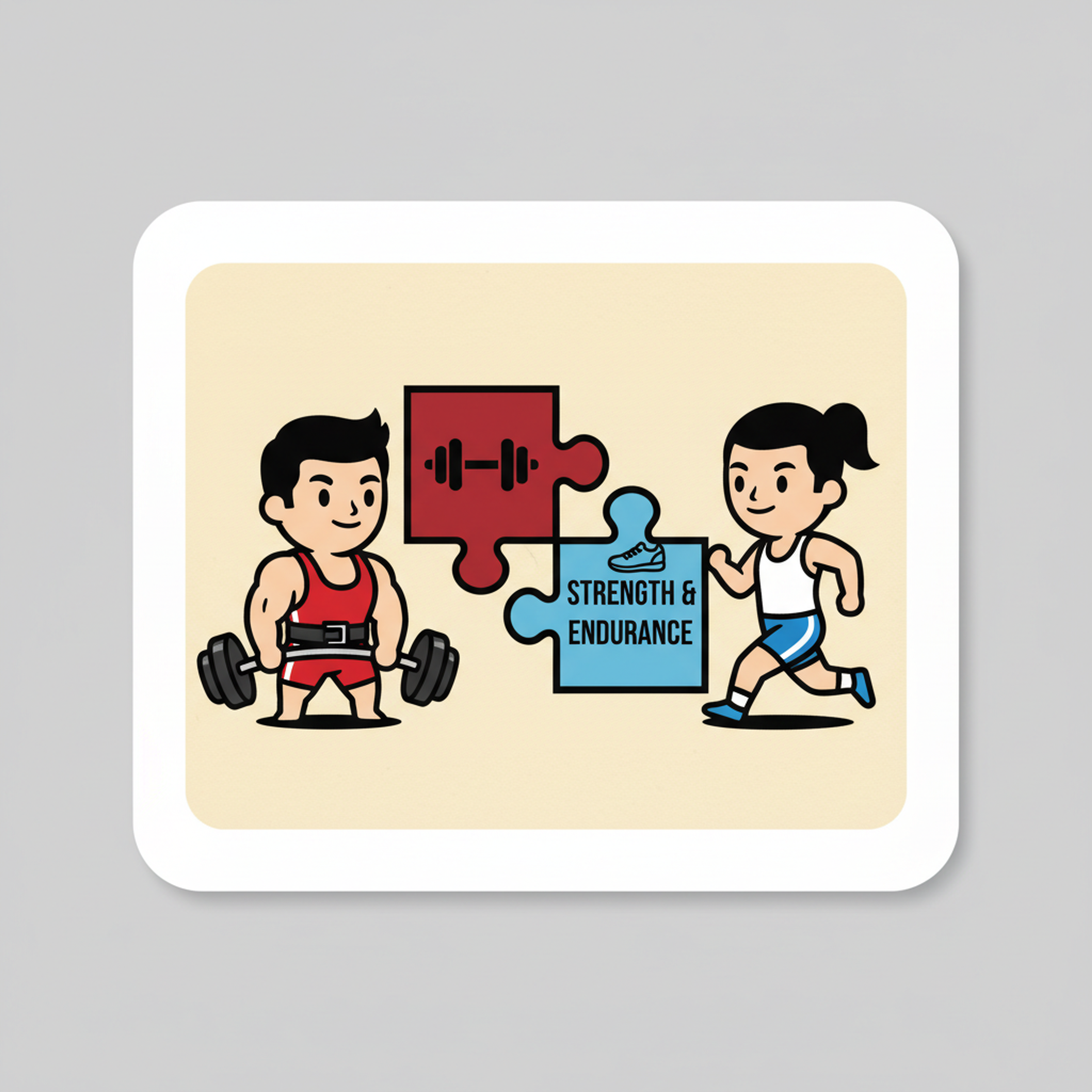
For decades, the "Interference Effect" was the boogeyman of strength sports. The dogma: cardio kills gains. The theoretical basis was that the cellular pathway for endurance (AMPK) directly inhibits the pathway for muscle growth (mTOR).
This is not a biological binary. It is a management problem.
Aerobic capacity is the substrate of recovery. It dictates how fast you recover between sets and how much volume you can tolerate weekly. The goal is not to avoid cardio—it is to isolate the specific variables that cause interference.
The Mechanism: AMPK vs. mTOR
- AMPK is triggered by sustained energy expenditure. It promotes mitochondrial adaptation and fat oxidation, and it inhibits mTORC1.
- mTORC1 is triggered by mechanical tension and amino acids. It drives protein synthesis and muscle growth.
If you flood the system with AMPK signals (via a hard run) immediately before or after lifting, you dampen the mTOR response. The key word is "immediately"—the duration of this interference is finite.
Three Ways to Reduce Interference
1. Temporal Separation
The AMPK signal peaks immediately post-exercise and returns to baseline within a few hours.
- Best (24-hour gap): Lift Monday, Wednesday, Friday. Cardio Tuesday, Thursday, Saturday.
- Good (6-hour gap): Cardio in the morning, lifting in the afternoon. Sufficient for most athletes to mitigate the majority of interference.
- Consolidated: If you must do both in one session, lift first. You need full glycogen stores and neural freshness for heavy work. Cardio becomes the cooldown.
2. Modality Choice
The type of cardio matters more than duration.
- Running (high interference): Running involves high eccentric loading from impact. This causes micro-trauma in the legs that directly competes with squat and deadlift recovery.
- Cycling / rowing / swimming (low interference): Concentric-dominant, minimal impact. They stress the cardiovascular system without damaging leg tissue.
If your goal is lower body strength, minimize running. Use the bike or the rower.
3. Priority Sequencing
Neural fatigue is systemic. HIIT before heavy singles will tank your force output.
- Heavy work comes first in any session. Cardio is either a cooldown or a separate session.
- Low-intensity steady-state (Zone 2) can work as a warm-up if kept under 10 minutes and does not deplete glycogen.
Practical Application
Scenario: The hybrid athlete (max deadlift + 5k time).
- Monday AM: Heavy lower body (squat/deadlift).
- Monday PM: Rest.
- Tuesday AM: Zone 2 run (recovery, not training).
- Tuesday PM: Upper body hypertrophy.
- Wednesday: High-intensity intervals (sprints or rowing).
The heavy lower session is separated from sprints by 48 hours. Tuesday's run is low intensity, which facilitates blood flow without adding eccentric damage.
Scenario: Cutting weight for a meet without losing strength.
- The error: 30 minutes of treadmill running after every squat session.
- The fix: Switch to incline walking or the stationary bike. Do 20 minutes post-workout or on off days. Incline walking removes the impact. Doing it post-workout ensures the heavy sets were performed with full glycogen. The interference from low-intensity walking is negligible.
Cardio does not kill gains. Poorly placed, high-impact cardio stacked on top of already-taxed legs kills gains.
About Rasmus
Powerlifter and coach with more than 7 years in the game.