"Good form" is a myth.
There is safe form, and there is efficient form. But there is no universal "perfect" form, because there is no universal skeleton.
Biomechanics is the study of levers. Your femur length, hip socket depth, and arm span dictate your mechanics—not a YouTube tutorial. Trying to squat like a Chinese Olympic lifter when you have the femurs of an NBA player is not discipline. It is physics denial.
Moment Arms: The Language of Leverage
The most critical concept in lifting is the moment arm: the perpendicular distance from the joint (fulcrum) to the line of force (gravity acting on the bar).
- Torque = Force × Moment Arm.
- The longer the moment arm, the more force the muscles must produce to move the same weight.
This is why two lifters with the same strength can move very different weights.
The Squat Example
- Long femurs (short torso):
To keep the bar over the mid-foot, a lifter with long femurs must lean forward more. This creates a long moment arm for the hips (glutes/lower back) and a short one for the knees (quads). "Sit back" cues work well here. Upright squatting is biomechanically impossible for these lifters. Low bar squatting is usually stronger.
- Short femurs (long torso):
These lifters stay upright easily. The moment arm is more balanced or knee-dominant. They can squat ass-to-grass with an upright torso. High bar suits them well.
Telling a long-femured lifter to "stay upright" is asking them to fall backward.
The Deadlift Example
- Long arms / short torso: Natural deadlifters. The torso stays upright, the hip moment arm is short. Conventional is usually their stronger stance.
- Short arms / long torso: They must bend over significantly further to reach the bar, exposing the lumbar spine. Sumo reduces this by allowing a more upright torso.
Biomechanical Adjustments by Body Type
You cannot change your bone length. You can change your stance, grip, and bar placement to alter the effective moment arm.
Anatomical Feature | Movement Impact | The Problem | Technical Adjustment
Long femurs / short torso | High hip torque in squat | Hips shoot back to maintain balance, creating a massive lever on the lower back | Widen stance; use heeled shoes; low-bar position
Short humeral length | Reduced ROM in bench | No disadvantage—you're built for it | None; use max-width grip
Long humeral length | Increased ROM in bench | Bar travels further; shoulder exposed to torque longer | Tuck elbows; rely on triceps/lats; consider board press
Long arms / short torso | Advantageous deadlift | No disadvantage | Use your reach; conventional
Short arms / long torso | Disadvantageous deadlift | Must round forward to reach bar; lumbar exposed | Widen stance; sumo or semi-sumo
Intra-Abdominal Pressure: The Hydraulic Column
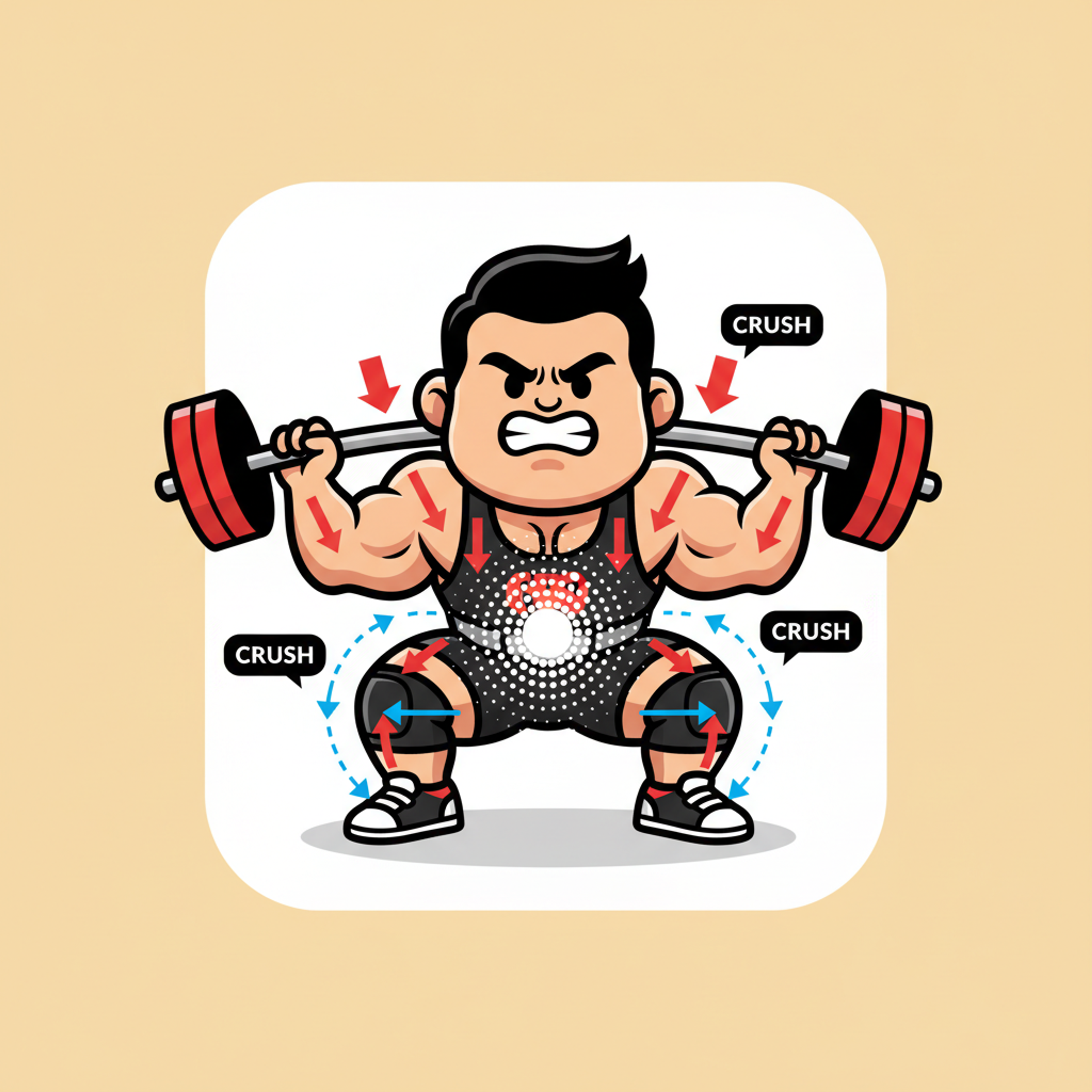
Your spine is a column of blocks. Under load, it wants to buckle. IAP (intra-abdominal pressure) is the hydraulic fluid that stabilizes it.
The Valsalva Maneuver—taking a deep breath into your belly and bracing against it—increases IAP. It pushes the organs against the spine from the front, providing rigidity.
The belt: A lifting belt is not a back brace. It does not mechanically support your spine. It provides a tactile wall for your abs to push against, which increases IAP and in turn stabilizes the spine. Wear it tight enough to push against, not so tight you can't breathe.
Practical Application
The bar path test:
- Film your squat from the side.
- Is the bar tracking vertically over the mid-foot?
- Bar over your toes: too much forward lean.
- Bar behind your heels: sitting too far back.
Adjust based on levers, not dogma:
- Heels lifting off the ground → lack of ankle mobility, or femurs too long for your current stance width. Widen your stance.
- Knees caving in → glutes not firing. Point toes out slightly.
Case Study: The Deadlift Stall
- Problem: You fail at the knees. Back rounds off the floor.
- Is it technical? (Do you know how to brace?) → Practice the competition lift, or use a paused deadlift at knee height.
- Is it a specific weakness? (Erectors too weak to hold position?) → Deficit deadlift for the quads/glutes, or weighted back extensions and rows for the erectors.
Accept your levers. Optimize your setup to minimize unfavorable moment arms. Fight physics and physics will break you.
About Rasmus
Powerlifter and coach with more than 7 years in the game.